As fitness professionals, we intuitively understand that a successful coaching strategy requires recognizing that every client who walks through our doors is entirely unique. They come to us with different goals, varying injury histories, erratic schedules, and wildly disparate recovery capacities. Yet, a glaring contradiction remains prevalent across the fitness industry: many training programs are still built using the exact same generalized approach.
This is where the illusion of simple personal training ends and true, elite coaching begins.
Two clients may enter your facility with identical goals—fat loss, hypertrophy, or improved athletic performance—but their optimal paths to achieving them will look completely different. One client might possess a high recovery capacity, enabling them to tolerate aggressive training volumes and high intensity. Another client might be battling chronic sleep deprivation, elevated life stress, systemic joint stiffness, or structural limitations that completely alter how their workload must be managed.
The core challenge of professional program design isn’t simply choosing exercises. The challenge is making the right strategic decisions for the individual standing in front of you. Successful programming is less about collecting an endless library of exercises and far more about mastering context and human biomechanics.
The Problem with Generic Programming and Training Templates
Generic programming and automated fitness templates exist for a reason.
Modern coaches are forced to act as multi-tasking entrepreneurs: managing client retention, balancing schedules, conducting comprehensive assessments, and adjusting sessions on the fly—all while trying to save time and maintain a semblance of work-life balance.
While standardized templates offer operational efficiency, a critical failure occurs when the template replaces the coach as the primary decision-maker.
[Rigid Template] ──> Ignores Client Context ──> Accelerated Burnout / Injury
[Systems-Based] ──> Processes Live Inputs ──> Dynamic, Tailored Progression
Many fitness programs fail because they operate on a flawed assumption: that all human bodies respond identically to a given training stimulus. An exercise sequence may look flawless on paper, but if it ignores the physiological variables that dictate how a client tolerates and adapts to mechanical tension, it is a liability.
- The Elite Response: A collegiate athlete with high metabolic efficiency and pristine joint mobility will thrive under aggressive progressive overload and high training volumes.
- The At-Risk Response: An active older adult dealing with osteoarthritis, compromised sleep quality, and structural movement limitations will quickly break down under that exact same volume.
Utilizing generic templates isn’t always a sign of laziness. More often, it’s the natural byproduct of a coach trying to manage too many complex variables without a reliable, scalable system to organize them.
Effective Personal Training is a Decision-Making Process
Exercises are merely tools. Program structures are just frameworks. Progression models are simply hypotheses. The ultimate factor that dictates your client’s long-term success is the quality of the coaching decisions behind those selections.
High-level coaching requires a continuous loop of assessment, prioritization, and real-time adjustment. As a professional, you must constantly evaluate the physiological state of your client to determine when to push training intensity, when to pivot to joint-friendly loading strategies, and when to prioritize systemic recovery over performance progression.
The exact same movement pattern can be a powerful catalyst for adaptation for one individual and completely inappropriate for another. Because of this, writing workouts should never be viewed as a static clerical task. It is a dynamic process of gathering data, organizing biomechanical variables, and applying strategy intelligently.
The 3 Stages of Intelligent Program Design
At its core, an optimized coaching methodology can be synthesized into a clean, logical data flow:
Inputs: The comprehensive data points you gather (biometrics, joint tolerance, stress levels, movement quality).
Strategy: The overarching programming logic you formulate based on those unique inputs.
Execution: The actual delivery of the workout, adjusted in real time based on daily client readiness.
When a coach skips the input phase or lacks a structured system to organize those inputs, the execution phase inevitably becomes inconsistent, inefficient, and potentially unsafe.
Beyond the Goal: What Variables Actually Change a Program?
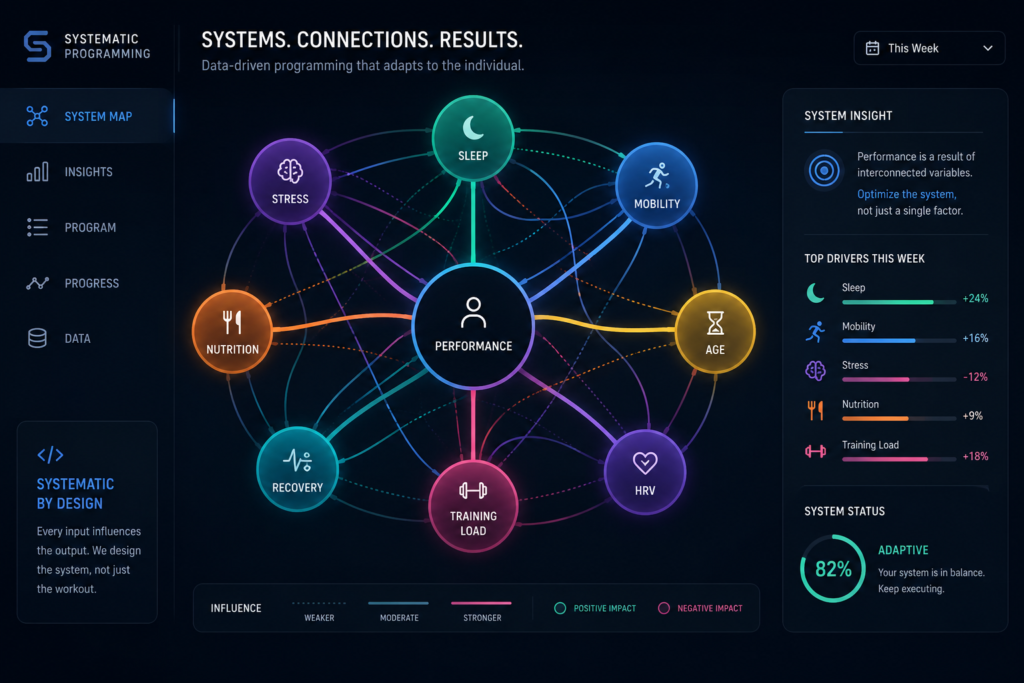
When designing custom training programs, look past the surface-level goal of “strength” or “weight loss.” True program optimization requires auditing an array of interconnected biological and lifestyle variables:
- Biological Age & Training Age: Chronological age dictates tissue recovery capacity, while training age determines neuromuscular efficiency and past movement patterns.
- Joint Tolerance & Movement Limitations: Structural restrictions or past orthopedic histories radically change what loading vectors are safe.
- Systemic Stress & Sleep Quality: Elevated cortisol and poor sleep drastically impair a client’s ability to recover from high-volume training, regardless of how perfect the exercise selection is.
- Daily Client Readiness: The immediate physiological and psychological state of the client when they step onto the training floor.
Key Takeaway: Context will always matter more than isolated exercise selection. The most impactful coaching adjustments are rarely based on changing a movement for the sake of novelty; they are based on understanding how the entire biological system surrounding the client influences their ability to adapt to stress.
Case Study: Programming for the 62-Year-Old Golfer
To see this systems-based approach in action, let’s analyze a common real-world scenario: programming for a 62-year-old amateur golfer presenting with tight hips, a stiff lumbar spine, and limited rotational mobility.
[62-Year-Old Golfer Case Study]
│
┌──────────────────────┴──────────────────────┐
▼ ▼
[The Generic Approach] [The Strategic Approach]
- Aggressive rotational drills • Build foundational stability
- Heavy axial loading • Joint-friendly strength paths
- Forcing ranges of motion • Unloaded mobility mastery
│ │
▼ ▼
Result: Increased Joint Stress Result: Tissue Resilience & Power
A generic, template-driven program typically jumps straight to the apparent goal: introducing high-velocity rotational medicine ball drills, aggressive end-range mobility work, or heavy axial loading patterns designed for a much younger athlete.
However, a strategic coach recognizes that the client’s perceived tightness isn’t a cue to blindly force range of motion. The underlying issue is often a lack of stability and tissue resilience. Forcing an unconditioned, stiff joint into high-velocity rotation is a fast track to a lower back injury.
In this scenario, the programming strategy must shift from immediate performance accumulation to foundational joint healthspan optimization. The primary objective is to build a body that can safely tolerate movement, absorb rotational forces, and recover efficiently.
An Optimized Strategic Framework for Rotational Athletes:
- Controlled Strength Development: Utilizing closed-kinetic chain exercises that maximize tension on target tissues while minimizing shear stress on arthritic joints.
- Joint-Friendly Loading Strategies: Utilizing tools like kettlebells, cables, and hex bars to modify leverage and accommodate structural limitations.
- Core Stability & Anti-Rotational Control: Teaching the client to stabilize the lumbar spine before asking it to produce dynamic rotation.
- Multi-Planar Hip Support: Improving active internal and external rotation of the femur to protect the lower back during the golf swing.
The resulting workout might look deceptively simple to an outside observer, but the clinical-grade reasoning behind it is entirely individualized. That is the distinct boundary between basic personal training and elite performance coaching.
The Shift Toward Systems-Based Coaching
As a fitness professional’s experience matures, they inevitably realize that elite programming relies less on discovering a “magic” new exercise and more on building repeatable backend frameworks that optimize their decision-making.
The industry’s top coaches are constant pattern-recognition engines. They notice exactly how emotional stress downregulates physical performance. They spot the subtle structural compensations that emerge when a client is fatigued. They instinctively know when movement quality must take absolute precedence over progression speed.
To scale this level of elite insight without burning out, you need a system. A structured coaching system acts as an analytical filter—organizing complex client inputs, simplifying clinical data, and bringing absolute consistency to your programming logic. It doesn’t replace your hard-earned coaching intuition; it provides the robust infrastructure required to unleash it seamlessly across your entire client roster.
Final Thoughts: Building Programs Around People
Every single person who steps into your training environment brings a deeply complex, unique web of goals, orthopedic limitations, sleep deficits, movement patterns, and life stressors. Your programming backend must reflect that reality.
The future of intelligent program design isn’t about making fitness unnecessarily complicated or confusing for the client. It is about maximizing the internal sophistication of how we, as coaches, organize client data, prioritize physiological variables, and scale personalized strategy.
The highest-performing training programs aren’t just built around exercises. They are built around people. And delivering that standard begins with acknowledging that every single client requires a completely different coaching strategy.