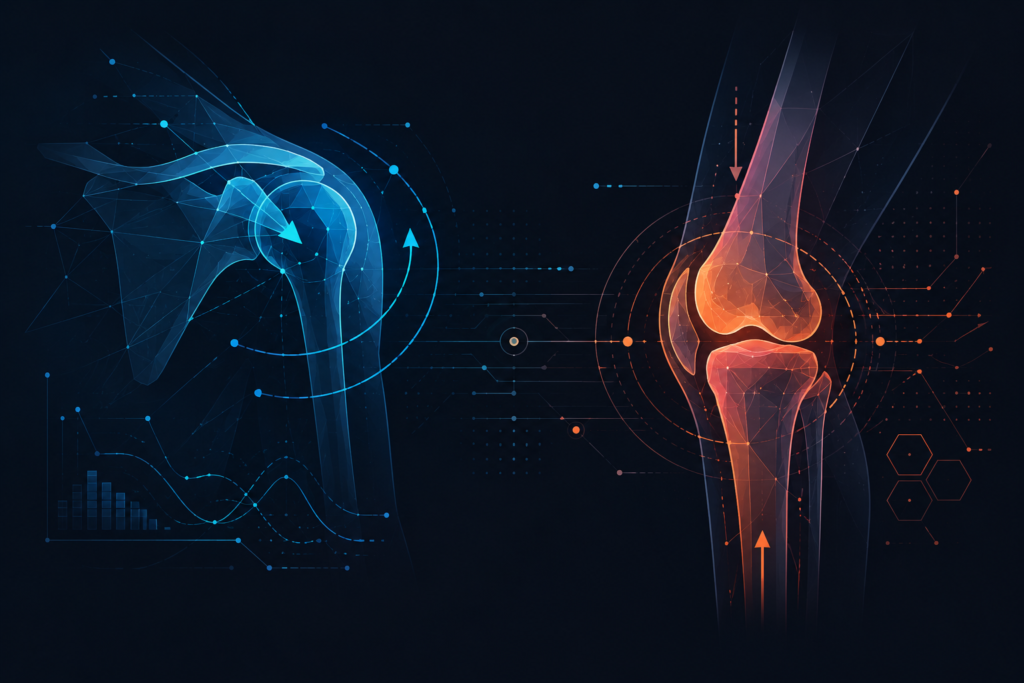
When a personal trainer, strength coach, or physical therapist opens a search browser and types in “best exercises for tennis players,” they are usually looking for a quick, tactical prescription. They want a specific medicine ball drill or a shoulder care routine they can immediately copy and paste. However, true athletic longevity requires a shift toward joint-first programming—a systematic methodology that recognizes an exercise without biological context is merely a guess, and in professional training, a guess is a severe liability.
To understand why generic programming fails your clients—and why high-level coaching requires an advanced, systematic infrastructure—we have to look past the surface-level goal of “tennis performance.” Instead, we must look at the exact physiological, structural, and orthopedic realities of the human beings standing in front of you.
Let’s analyze the exact same sport goal through two completely different biological lenses, adding real-world orthopedic complexities to the mix.
The Case Study: One Goal, Two Different Histories
Imagine two male clients walk into your facility in the exact same week. Both present with the identical, highly specific objective: “I want to get back on the tennis court, improve my court coverage, power up my serve, and do it completely pain-free.”
If you are operating out of a standard fitness template, or if you are simply hunting for “tennis workouts” online, you might be tempted to put them through a highly similar structural block. After all, the sport demands are identical: lateral deceleration, thoracic rotation, overhead force production, and multi-directional speed.
However, when we audit their biological, lifestyle, and injury variables, a massive architectural divide opens up.
[ The Tennis Performance Goal ]
│
┌─────────────────────────┴─────────────────────────┐
▼ ▼
[ Client A: 30-Year-Old Male ] [ Client B: 60-Year-Old Male ]
- High tissue elasticity • Degraded tissue compliance
- History: Torn Rotator Cuff • History: Past Knee Surgery
- Objective: Metabolic Engine & Whip • Objective: Joint Armor & Brakes
Client A: The 30-Year-Old Male (Torn Rotator Cuff)
- The Biological Variables: He possesses high natural tissue elasticity, excellent baseline joint clearance, and strong neuromuscular sequencing. He is in overall good physical shape.
- The Injury Context: He has a history of a torn rotator cuff. While his systemic structural tolerance is high, his shoulder complex has a localized stability deficit. His overhead serve mechanics present an immediate risk of compensation, meaning his lower back or thoracic spine might try to over-rotate to make up for a lack of stable shoulder velocity.
Client B: The 60-Year-Old Male (Past Knee Surgery)
- The Biological Variables: He is navigating age-related decreases in soft-tissue compliance and a lifetime of structural micro-trauma, though he is in overall good health. His nervous system takes longer to process rapid, chaotic changes in direction.
- The Injury Context: He underwent knee surgery a couple of years ago. Although healed, the joint has compromised local structural tolerance. The sudden, violent force of stopping, cutting, or backing up on a tennis court introduces massive shear stress to a joint capsule that already has an altered biomechanical baseline.
Programming Through the BP-6 Pillars Framework
Because their underlying biological systems and joint histories are completely different, their programming architecture must be built on entirely separate physiological pathways. We handle this seamlessly by utilizing the BP-6 Pillars Framework to categorize and prioritize our coaching decisions.
How We Program Client A (The 30-Year-Old with the Rotator Cuff History)
For this athlete, the primary objective is to build a massive metabolic capacity and unlock elite force production, but we must protect and stabilize the shoulder complex first.
- BP-3 (COORDINATION): Before he ever swings a racquet or throws a heavy medicine ball, we must program neuromuscular timing and sequencing. We focus heavily on upward rotation of the scapula and thoracic mobility. If his mid-back cannot rotate, his compromised rotator cuff will be forced to absorb all the stress of a high-velocity tennis swing.
- BP-1 (ARMOR): We build structural resilience and localized strength around the glenohumeral joint. Instead of high-risk overhead movements, we utilize closed-kinetic chain exercises (like variations of planks and bear crawls) and targeted rotator cuff centration drills to pull the humeral head safely into the socket.
- BP-4 & BP-5 (ENGINE & WHIP): Once the shoulder is stabilized, we safely unlock his athletic potential. We program aggressive anaerobic intervals for court endurance and multi-planar power drills—using lower-body and core-driven power expressions to generate speed, protecting his arm from doing all the work.
How We Program Client B (The 60-Year-Old with the Knee Surgery History)
For the active older adult with a history of joint surgery, jumping straight into agility drills or aggressive conditioning is a recipe for re-injury. His program must be built with a Joint-First, safety-aware methodology.
- BP-1 (ARMOR): Our absolute first priority is building a structural “shield” of strength and tissue resilience directly around that surgical knee. We utilize joint-friendly, isometric, and controlled eccentric loading strategies (like step-ups and split squat variations) to thicken the surrounding tendons and restore quad-to-hamstring balance without over-compressing the joint space.
- BP-2 (BRAKES): Tennis is a sport of sudden stops. Before this client can safely chase down a ball, his nervous system must know how to absorb force. We heavily program stability and deceleration control. If we don’t explicitly train his hips and glutes to act as the primary braking system, his surgical knee will take the brunt of the kinetic trauma on the court.
- BP-6 (RESET): Because tissue compliance decreases with age, we hardcode active mobility, tissue hydration strategies, and down-regulation protocols directly into his weekly schedule to manage joint inflammation and optimize recovery between court sessions.
Moving Beyond "On-the-Fly" Guesswork
What happens on the average gym floor when a coach realizes a generic tennis template doesn’t account for a torn rotator cuff or an old knee surgery? Usually, they try to “modify it on the fly.” They see the client wince or struggle during a movement, and they suddenly call an audible—swapping a hard exercise for a random, watered-down alternative.
This reactive approach is a massive professional liability. It is highly stressful for the coach, creates a fragmented experience for the client, and completely stalls long-term results.
True professional program design means you stop calling random audibles. It means you implement a systematic infrastructure that automatically audits all 15+ critical client variables—including age, specific injury histories, surgeries, and joint tolerance—before a single exercise is ever placed on their calendar.
The Professional Standard: You do not need more random exercises found on social media. You need a better system for organizing information, simplifying your daily workflow, and bringing absolute logic to your decision-making.
Final Thoughts: The Operating System for Intelligent Coaching
Every client who walks through your doors is an incredibly complex web of biology, orthopedic history, and lifestyle stress. Treating them with generic, sport-specific templates is an outdated practice that limits your professional scale, contributes to severe programming fatigue, and puts your clients at risk.
The highest-performing coaches in the fitness industry don’t just collect exercises—they build repeatable backend frameworks that optimize how they think. The future of program design belongs to those who build their training around the specific person, prioritizing a Joint-First philosophy that ensures long-term performance and physical longevity.
And delivering that elite standard begins with recognizing that a 30-year-old with a rotator cuff injury and a 60-year-old with a past knee surgery can never share the exact same court program.