Bio-Performance Engine
Six Pillars. One Complete Program. Built for Every Client.
Structured sessions and four-week progressions built around joint history, mobility limits, and recovery load. In seconds.
See PricingThis engine on its own is $29 a month. All three are $19 while Founding spots last. Cancel anytime, no contracts.
Why I built it
A full book of clients is a good problem to have. It is still a problem.
One has a repaired shoulder and two more weeks before you load it overhead. One is three sessions into a progression you need to bump today. One has a medication that makes heart rate useless as a gauge. You know all of it. You just have to hold all of it, across a morning that runs back to back from six until the floor clears.
It should all be in my notes. But notes are a memory aid. What I wanted was a process that could not forget.
Most of the apps I tried were flashy. Plenty of animation, plenty of look-what-I-can-do. What I could not find was one that actually accounted for my 8am: 62 years old, a few surgeries behind him, on medication, and playing golf on Saturday.
That is the Bio-Performance Engine. Not a workout generator. A process that holds every variable you already know about, so nothing quietly drops off the list when the morning is full.
How it works
1. Answer nine questions. Age and sex, primary goal, sport or focus, session length, readiness, training and sleep and stress, pain and injury history and medications, equipment, coach mode. One at a time, or paste everything at once if you already have it written down.
2. The engine builds against six pillars.
- BP-1 Armor. Strength and muscle.
- BP-2 Brakes. Stability and joint control.
- BP-3 Coordination. Coordination and timing.
- BP-4 Engine. Conditioning and work capacity.
- BP-5 Whip. Speed and power.
- BP-6 Reset. Recovery and restoration.
3. You get the session and the week around it. A full session plan with tempo, RPE, and coach cues, plus the four-week progression it sits inside.
4. The next session starts where you left off. Ask for a Client Profile Card and the engine hands back a compact block holding everything it knows about that client. Paste it at the top of a new chat and you carry straight on. You never re-enter the repaired knee, the medication, or the seventy percent shoulder range.
A real session
What the coach typed
What came back
Strategy Blueprint
Phase: Week 1, Foundation
Primary BP Pillar: BP-1 Armor
Secondary Pillars: BP-2 Brakes, BP-3 Coordination, BP-4 Engine
Objective: Build lean muscle and fat-loss work capacity while protecting the right knee, improving balance, and restoring usable hip and shoulder range for golf. Today's session emphasizes joint-friendly strength, controlled rotation, and low-skill conditioning without relying on heart-rate targets due to blood pressure medication.
Session Plan, 60 min
Scroll the table sideways on a phone.
| # | Exercise | Sets/Reps | Tempo | RPE | Pillar | Coach Cue |
|---|---|---|---|---|---|---|
| 1 | Cable Pull Through | 3 x 10 | 3-1-1 | 6 | BP-1 | Hips back, ribs down, finish tall with glutes. |
| 2 | Leg Press Moderate | 3 x 10 | 3-1-1 | 6-7 | BP-1 | Full foot pressure, smooth knees, no bouncing. |
| 3 | Low Step-Up with Support | 3 x 8/side | 2-1-1 | 6 | BP-2 | Drive through whole foot; use rail lightly for balance. |
| 4 | Incline DB Press, Neutral Grip | 3 x 8-10 | 2-1-1 | 7 | BP-1 | Shoulders set, neutral wrists, press without shrugging. |
| 5 | Chest Supported Row | 3 x 10 | 2-1-1 | 7 | BP-1 | Pull elbows back, keep neck relaxed. |
| 6 | Standing Split-Stance Cable Press | 2-3 x 8/side | 2-1-1 | 6 | BP-2 | Ribs stacked, punch forward, don't rotate. |
| 7 | Pallof Press | 3 x 10/side | 2-1-2 | 6 | BP-2 | Brace like you're resisting the golf turn. |
| 8 | Cable Chop, Controlled | 2 x 8/side | 2-1-2 | 6 | BP-3 | Hips guide the motion; avoid twisting through the low back. |
| 9 | Sled Push or Backward Sled Drag | 40s / 40s x 4 | Steady | 6-7 | BP-4 | Drive smooth, stay tall, breathe through the effort. |
Live adjustment rules
- If knee discomfort appears: reduce step height, switch to TRX assisted squat or backward sled drag.
- If balance looks unstable: keep one hand supported on step-ups and remove loaded carries today.
- If shoulders feel restricted: use machine chest press neutral or landmine press instead of DB press.
- With blood pressure medication: use RPE, not heart rate, and avoid rushing floor-to-standing transitions.
Every constraint that went in came back out as a decision. Blood pressure medication became RPE instead of heart rate. Balance issues kept the step-ups supported. Seventy percent shoulder range became a neutral grip with a landmine swap ready.
Where the session ends up
Every plan is a table you copy. It goes into a workbook you keep in your own Drive, one per client. This is that workbook.
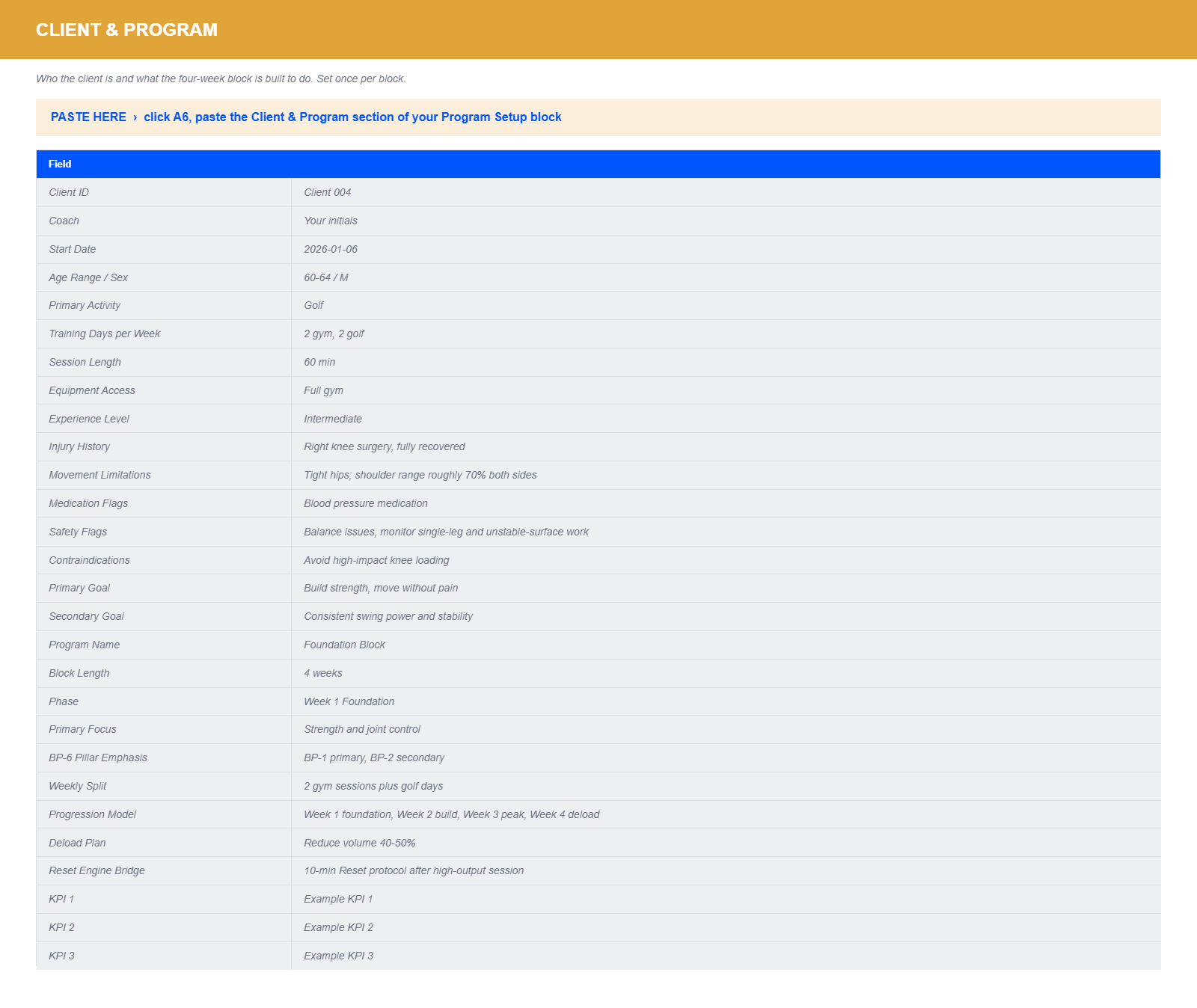
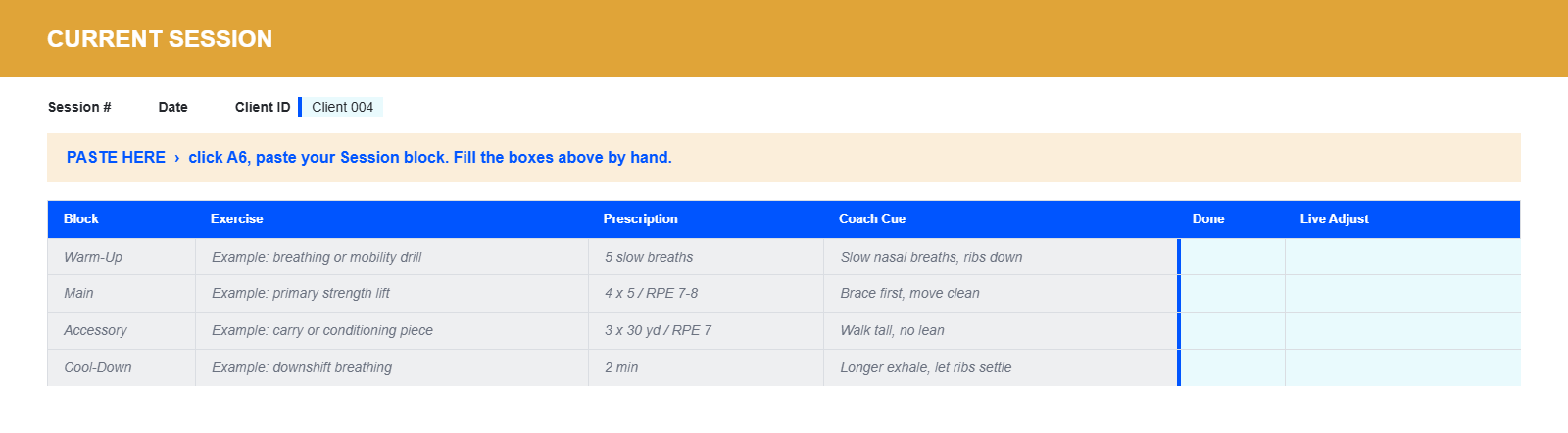
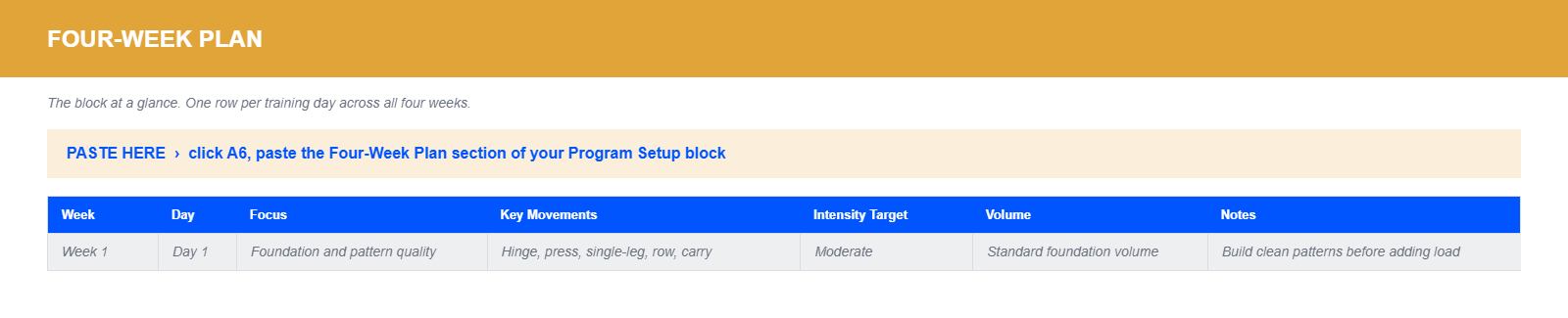
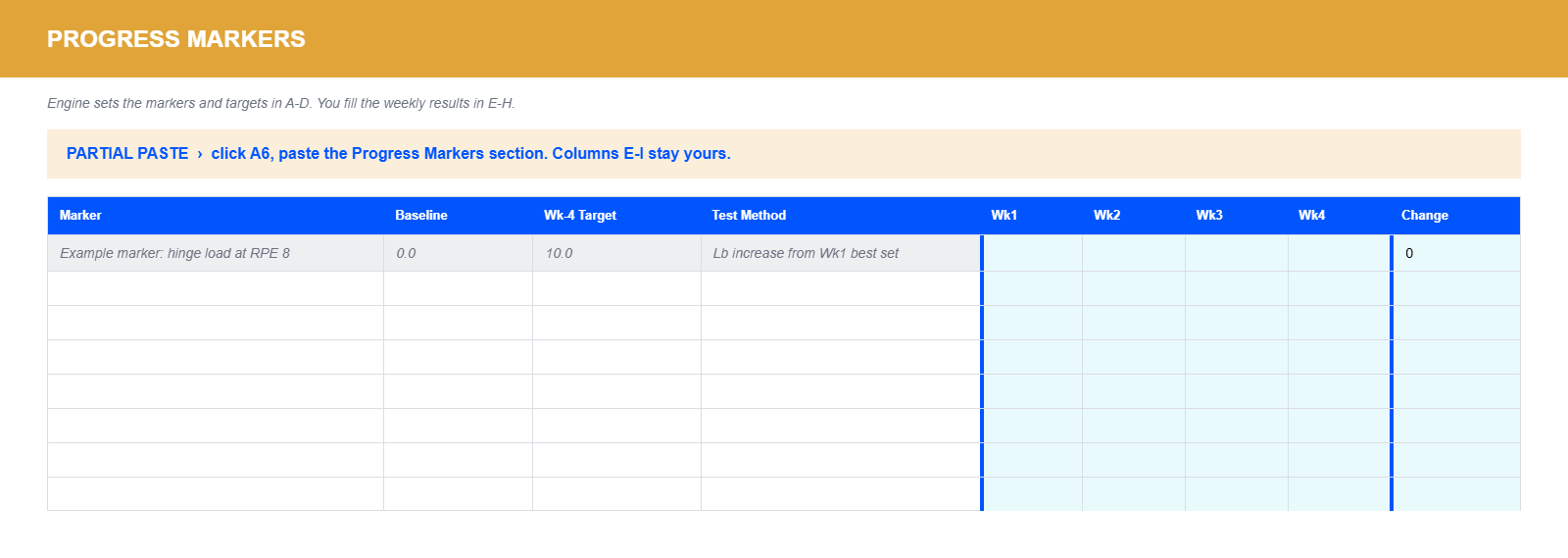
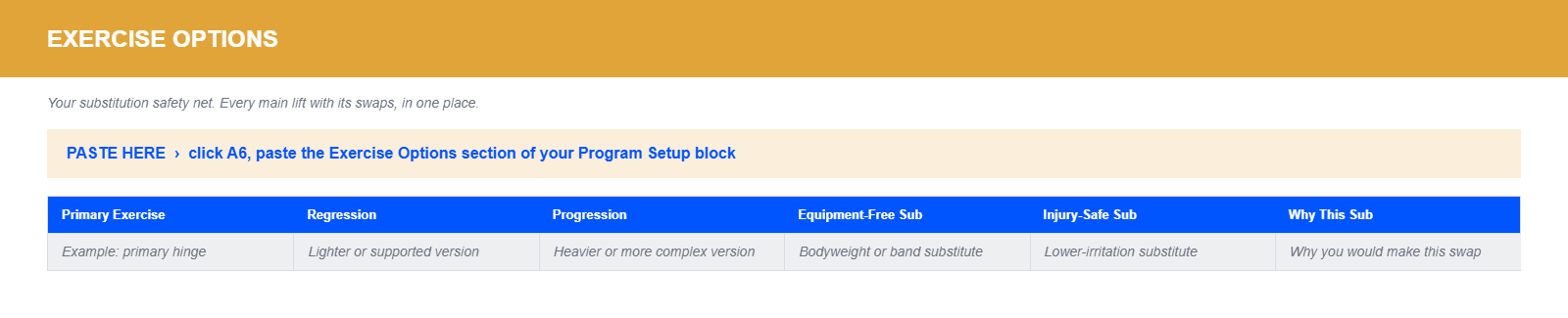
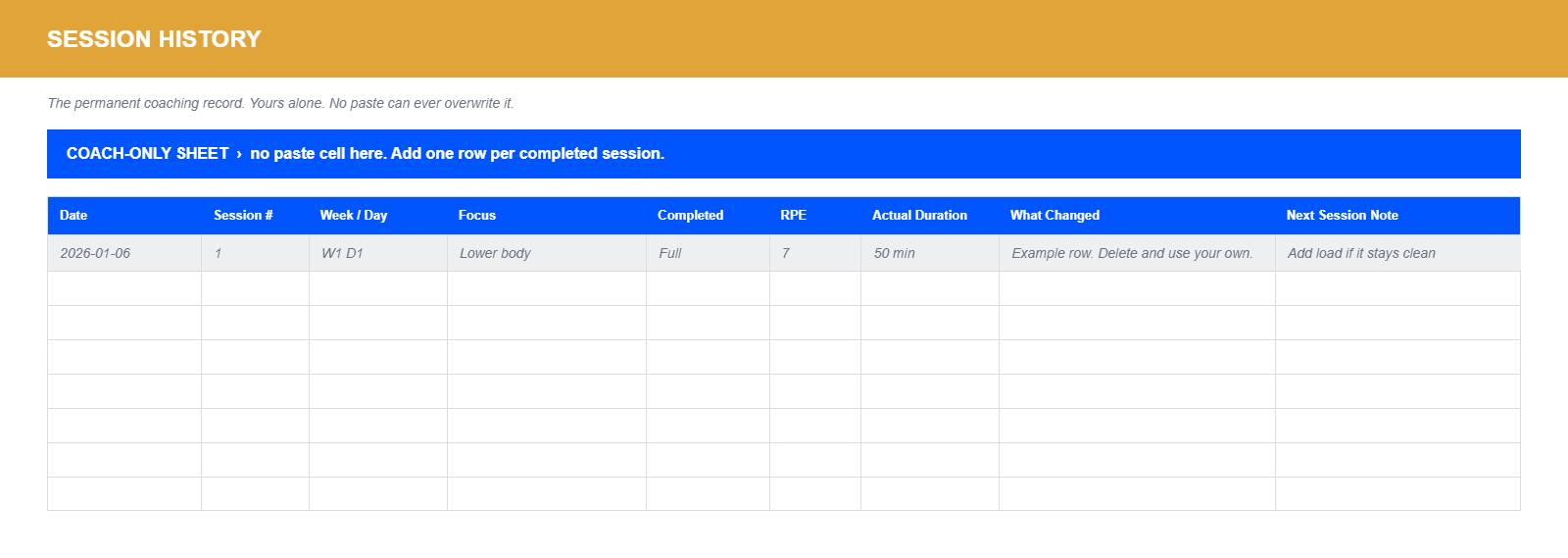
Works in Google Sheets and Microsoft Excel. Members get the template at sign-in.
Try it with one of your own clients.
Seven days free. Bring the client you were already going to program for tomorrow morning.
Start 7-day trialCard required. We email you on day 5 so nothing is a surprise, and if you cancel before day 7 you pay nothing.
Who it's for
Coaches working with active adults and older athletes. Golf, tennis, pickleball. Clients with surgical history who have been cleared to train and are not interested in being handled gently.
If your intake already surfaces this information and you are tired of carrying all of it in your head through a full morning, this is built for you.
Who this is not for
If your clients are young, healthy, and carrying nothing, most of what this engine does is work you do not need. You will get a good session and wonder what the fuss was about.
If you want an app your clients log into, this is not that. The output comes to you. What the client sees is what you hand them.
And if you want a plan you can run without reading it first, do not buy this. Every output assumes you check it before anyone picks up a barbell.
What is shown above is one session.
Members also get the four-week progression it belongs to, fuel and hydration guidance, KPI tracking with test protocols, a client-facing version to send, Client Profile Cards so a returning client never gets entered twice, and Copy-Ready, Phone View, and Workbook Block delivery formats.
See PricingThis engine on its own is $29 a month. All three are $19 while Founding spots last. Cancel anytime, no contracts.