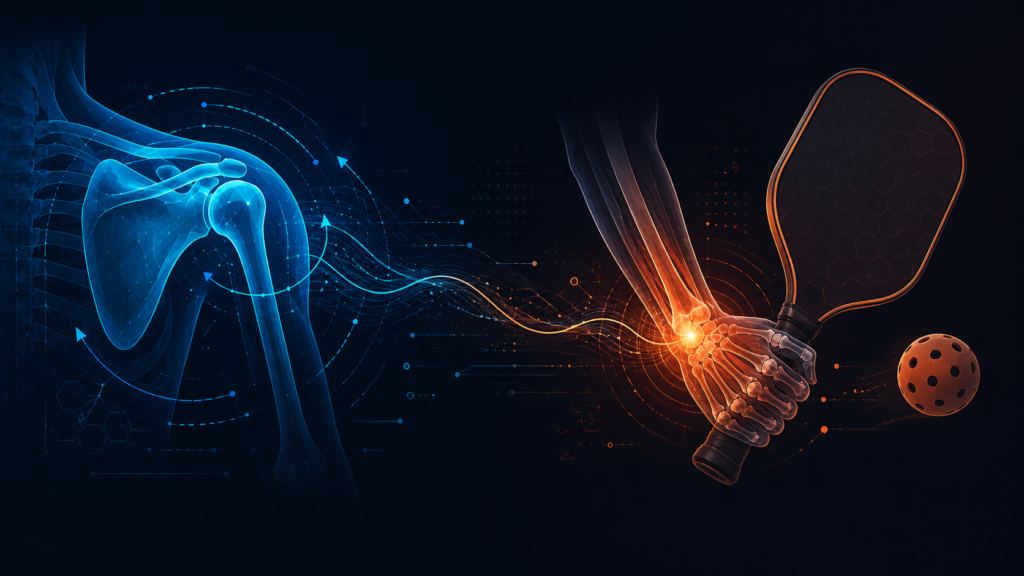
I have a member who plays pickleball four mornings a week, mostly at the net trading dinks in mixed doubles. Her wrist started aching a few months ago, right where the forearm meets the hand. Ice, a wrist brace, a week off. It would calm down, she’d go back to full volume, and within a few weeks the same ache would show up again.
Dinking looks gentle from the sideline. It isn’t. It’s hundreds of small, repetitive wrist and forearm movements in a single session, and where that load gets absorbed matters more than how soft the shot looks.
The wrist is doing work the shoulder should be sharing
Every dink sends a small amount of force back up through the paddle into the wrist. On its own, that’s nothing a healthy wrist can’t handle. The problem shows up when the shoulder blade isn’t stabilizing the arm through contact, so the wrist and forearm end up absorbing load that should be distributed further up the chain, over and over, for an hour at a time.
Nobody’s watching for that on the court. It just looks like a lot of dinking.
Bracing the wrist doesn’t touch what’s actually happening at the shoulder
The instinct is to treat the wrist directly, since that’s where it hurts. Rest, a brace, maybe some grip strengthening once it settles. None of that is wrong exactly. But going straight back to a full mixed doubles schedule once the ache quiets down just reloads the same unsupported pattern, and it comes right back within a few weeks.
What actually worked
The work started at her shoulder blade, not her wrist. Wall slides, band pull-aparts, drills that taught the shoulder to actually engage and control the arm through contact instead of leaving the forearm to absorb everything on its own.
Once that control was in place, we reintroduced wrist and forearm loading gradually, eccentric work first, built up slowly enough for the tendon to adapt instead of just surviving the next session. Six weeks in, she’s back to her full schedule and the ache hasn’t returned.
Small aside: this is the kind of case-specific sequencing the Bio-Performance Engine already has built in, so I’m not reconstructing the logic from scratch every time the same pattern walks through the door.
Ramses
Personal Trainer and Group Fitness Instructor