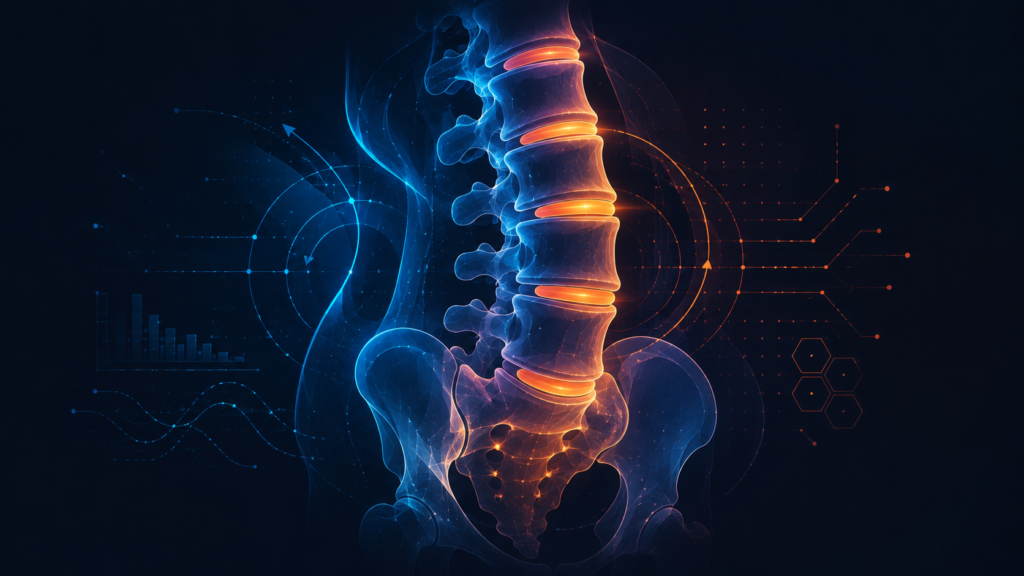
I have a member who plays golf every Saturday. Sixty-two, a repaired knee, blood pressure medication, and hips that measure out around seventy percent of normal range. He wants more distance off the tee. What he actually has is a lower back that’s doing a job it was never built for.
This is one of the most common things I see walk onto the floor from the golf course, and it gets misdiagnosed constantly, by the golfer, by well-meaning training partners, sometimes by coaches who should know better.
The swing doesn’t care where the rotation comes from
A golf swing needs a certain amount of turn. Hips rotate back, shoulders rotate further, and the gap between the two is where a lot of the power in the swing actually comes from.
If the hips can only turn so far and stop, the body doesn’t quit early. It keeps looking for rotation somewhere, and the lumbar spine will happily supply it. The swing looks fine from the tee box. Nobody notices the compensation happening between two lumbar vertebrae, dozens of times a round, for years.
The back pain shows up eventually. By the time it does, most people go looking for a back fix. Ice, a foam roller, maybe a few weeks off. None of that touches the actual problem, because the back was never broken on its own. It was covering for hips that stopped doing their job.
Stretching harder is the wrong instinct
The obvious response is to go after the hips directly. Aggressive stretching, deep lunges, forcing the range open. I understand the instinct. If the hips are tight, open the hips.
But a hip that’s been stiff for years usually isn’t stiff because the tissue is short. It’s stiff because the body doesn’t trust that joint to control the range it already has. Force it into a bigger range before it can control what it’s got, and you haven’t fixed anything. You’ve handed an unstable joint a bigger window to fail in, right next to a spine that’s already compensating.
What actually moves the needle
For this member, the work didn’t start with his hips at all. It started with teaching his core to resist rotation instead of produce it. Standing Pallof presses, split-stance cable work, all built around one instruction: brace like you’re resisting the golf turn, not creating it.
Once that control was in place, we could load the hips carefully. Step-ups, controlled single-leg work, and only then, gradual range work his body could actually own instead of borrow for a swing and default back out of for the rest of the day.
Twelve weeks in, his hip range is up. More importantly, the back has stopped talking. Nobody had to force a single stretch to get there.
This is the reasoning I don’t want to redo from scratch every time
That whole sequence, and knowing which pillar to lean on first given his knee, his medication, and his balance concerns, took years to build into instinct. It’s also exactly the kind of reasoning the Bio-Performance Engine runs through for every client I put in front of it, golfer or not.
I still make the calls. I’m just not reconstructing the logic from a blank page every Monday, for every golfer walking off the same course with the same complaint.
Ramses
Personal Trainer and Group Fitness Instructor